
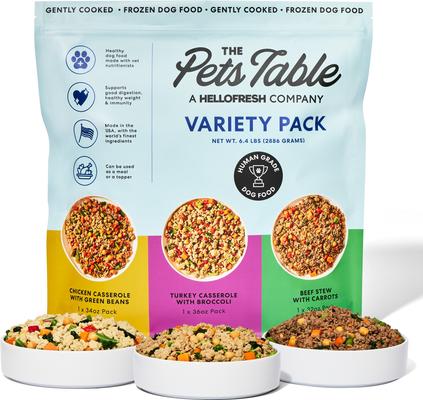
Freshly-Made Frozen Human-Grade Variety Pack Dog Food, 32 to 36-oz pouches, 3 count
The Pets Table Freshly-Made Frozen Human-Grade Variety Pack Dog Food, 32 to 36-oz pouches, 3 count earns a Sniff Score of 59/100 (C) with Fair evidence. Zero controversial ingredients flagged. Score capped at 59 due to no AAFCO statement.
Graded by The Sniff System
Reasonable protein quality. chicken delivers solid amino acid coverage.
Quality fat sources: named fat with marine oil (EPA and DHA source).
Includes egg, named fish, or organ meat for diverse high-bioavailability protein.
No AAFCO statement. Nutritional completeness unverified.
Wet and fresh foods contain more water than kibble (typically 65-78%). On a dry-matter basis, this food's protein content is roughly 50%, comparable to premium kibble (typically 30-45% DMB protein).
Read why each ingredient is good or bad for dogs.
- 1protein animalchicken
Real meat. Primary protein source, with the amino acid profile dogs actually evolved to eat.
- 2legumechickpeas
Also called garbanzo beans. Affordable plant protein source, part of the legume stack the FDA examined in its heart-disease investigation. See why →
- 3protein animalchicken liver
Organ meat. Dense in protein, iron, vitamin A, and the B vitamins. Among the most nutrient-rich ingredients a dog can eat.
- 4vegetablecarrots
Real vegetable. Fiber, beta-carotene, and a small amount of antioxidant value.
- 5green beans
Real vegetable. Fiber and a small amount of vitamins. Often used in weight-management formulas because it bulks up a meal without adding calories.
- 6vegetablesweet potato
Complex carb with fiber and beta-carotene. Gentle on the stomach.
- 7fruitapples
Real fruit, some fiber and antioxidants. The amount in kibble is too small to matter much.
- 8vegetablespinach
Leafy green. Some iron, vitamin K, and fiber. The dose in kibble is small but it's real food.
- 9fatsalmon oil
Pure omega-3s. The thing skin-and-coat formulas are usually built around.
- 10mineraltricalcium phosphate
Calcium and phosphorus source. Same role as dicalcium phosphate, slightly different ratio.
- 11fatsunflower oil
Common plant oil. Useful in moderation for omega-6, though too much skews the omega ratio against the dog's favor.
- 12mineralsalt
Sodium chloride. Required at small doses for normal physiology. Not a quality concern in standard amounts.
- 13vitamins & minerals
- 14yeast culture
Fermented yeast. Source of B vitamins and beta-glucans that some research suggests support immune function.
- 15vitaminvitamin e supplement
Required nutrient and a natural antioxidant. Often pulls double duty as a preservative.
- 16vitamind-calcium pantothenate
B vitamin (B5). Standard inclusion in complete dog foods.
- 17vitaminvitamin a supplement
Vitamin A in stable, standardized form. Required for vision, immune function, and growth.
- 18vitaminniacin supplement
B vitamin (B3). Required in complete dog foods, added as a supplement to standardize the dose.
- 19vitaminriboflavin supplement
B vitamin (B2). Required in complete dog foods. The standardized form ensures consistent dosing.
- 20vitaminvitamin d3 supplement
The active form of vitamin D dogs need. Required for calcium absorption and bone health.
- 21vitaminthiamine mononitrate
B vitamin (B1). Essential for nervous system function. Cooked-in vitamin loss is why thiamine is always added back.
- 22vitaminvitamin b12 supplement
Essential for red blood cell formation and neurological function. Plant ingredients lack B12, so it has to be added.
- 23vitaminfolic acid
B vitamin (B9), essential for cell function. Standard in complete dog foods.
- 24vitaminpyridoxine hydrochloride
B vitamin (B6). Essential for protein metabolism. Standard inclusion in complete formulas.
- 25zinc amino acid chelate
Zinc bound to amino acids for better absorption. Same idea as zinc proteinate, the premium form of the mineral.
Showing first 25 of 89. Position 1-5 has the largest weight in the recipe.
24 of 25 ingredients have a curated note. Coverage grows over time.