
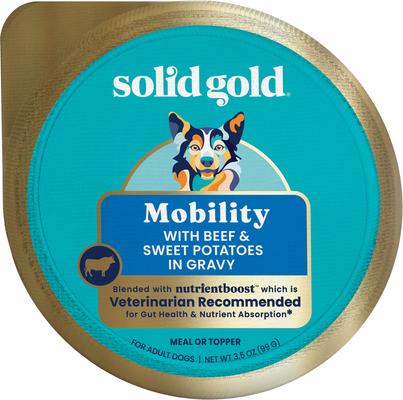
Mobility Support Beef & Vegetables Wet Dog Food, 3.5-oz cup, case of 6
Solid Gold Mobility Support Beef & Vegetables Wet Dog Food, 3.5-oz cup, case of 6 earns a Sniff Score of 50/100 (C) with Fair evidence. 1 controversial ingredient flagged. Score capped at 59 due to no AAFCO statement.
Graded by The Sniff System
Reasonable protein quality. chicken delivers solid amino acid coverage.
Quality carbohydrate sources with fermentable fiber.
No declared omega-3 source. Fish oil, salmon oil, and algae oil all absent.
No AAFCO statement. Nutritional completeness unverified.
Controversial ingredients · 1
- sodium seleniteSynthetic selenium source. Selenium is essential, but sodium selenite has a narrower safety margin than organic alternatives like selenium yeast. Better-formulated foods use the organic form.
Every flagged ingredient has a published basis (confirmed harm / regulatory action / precautionary). See methodology →
Wet and fresh foods contain more water than kibble (typically 65-78%). On a dry-matter basis, this food's protein content is roughly 54%, comparable to premium kibble (typically 30-45% DMB protein).
Read why each ingredient is good or bad for dogs.
- 1beef broth
Real broth. Adds flavor and moisture, signals the recipe leans on real meat.
- 2protein animalchicken
Real meat. Primary protein source, with the amino acid profile dogs actually evolved to eat.
- 3protein animalbeef
Real meat. Dense in protein and iron. Some dogs are sensitive to it, but for most it's an excellent base.
- 4vegetablesweet potato
Complex carb with fiber and beta-carotene. Gentle on the stomach.
- 5shrimp
- 6chicken tendon
- 7vegetablecarrots
Real vegetable. Fiber, beta-carotene, and a small amount of antioxidant value.
- 8green beans
Real vegetable. Fiber and a small amount of vitamins. Often used in weight-management formulas because it bulks up a meal without adding calories.
- 9vegetablepumpkin
Soluble fiber that supports stool quality. Mild and well-tolerated.
- 10glycine
- 11fatsunflower oil
Common plant oil. Useful in moderation for omega-6, though too much skews the omega ratio against the dog's favor.
- 12animal plasma
- 13fiberguar gum
Thickener common in wet food. Emerging research on emulsifiers and the gut microbiome, but no smoking gun in dogs yet.
- 14tapioca starch
Refined cassava starch, used as a binder. Easy to digest, low on nutrition.
- 15vitaminvitamin e supplement
Required nutrient and a natural antioxidant. Often pulls double duty as a preservative.
- 16vitaminvitamin a supplement
Vitamin A in stable, standardized form. Required for vision, immune function, and growth.
- 17vitaminniacin supplement
B vitamin (B3). Required in complete dog foods, added as a supplement to standardize the dose.
- 18vitamind-calcium pantothenate
B vitamin (B5). Standard inclusion in complete dog foods.
- 19vitaminthiamine mononitrate
B vitamin (B1). Essential for nervous system function. Cooked-in vitamin loss is why thiamine is always added back.
- 20beta-carotene
- 21vitaminbiotin
B vitamin that supports skin and coat health. Required for AAFCO-complete formulas.
- 22vitaminriboflavin supplement
B vitamin (B2). Required in complete dog foods. The standardized form ensures consistent dosing.
- 23vitaminvitamin b12 supplement
Essential for red blood cell formation and neurological function. Plant ingredients lack B12, so it has to be added.
- 24vitaminpyridoxine hydrochloride
B vitamin (B6). Essential for protein metabolism. Standard inclusion in complete formulas.
- 25vitaminfolic acid
B vitamin (B9), essential for cell function. Standard in complete dog foods.
Showing first 25 of 35. Position 1-5 has the largest weight in the recipe.
20 of 25 ingredients have a curated note. Coverage grows over time.