
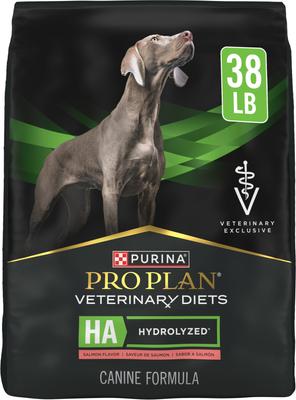
HA Hydrolyzed Salmon Flavor Dry Dog Food, 38-lb bag
Purina Pro Plan Veterinary Diets HA Hydrolyzed Salmon Flavor Dry Dog Food, 38-lb bag earns a Sniff Score of 35/100 (D) with Fair evidence. 3 controversial ingredients flagged. Score capped at 64 due to 3 WATCH ingredients.
Graded by The Sniff System
Reasonable protein quality. corn starch delivers solid amino acid coverage.
Quality fat sources: named fat with marine oil (EPA and DHA source).
AAFCO feeding trial substantiation for not stated.
Contains tbhq. Prohibited in Japan. Less data than BHA/BHT; emerging immunotoxicity signals..
Contains menadione. Banned for human OTC use but tolerated at AAFCO-permitted levels in pet food. The only AAFCO-permitted vitamin K source..
Controversial ingredients · 1
- menadioneSynthetic vitamin K3. Banned in human supplements due to toxicity concerns at high doses. Permitted in pet food but premium brands use natural vitamin K alternatives.
Every flagged ingredient has a published basis (confirmed harm / regulatory action / precautionary). See methodology →
Read why each ingredient is good or bad for dogs.
- 1corn starch
- 2hydrolyzed soy protein isolate
- 3fatcoconut oil
Saturated fat with medium-chain triglycerides. Mostly marketing in the doses kibble uses, but harmless.
- 4mineraltricalcium phosphate
Calcium and phosphorus source. Same role as dicalcium phosphate, slightly different ratio.
- 5partially hydrogenated canola oil preserved with tbhq
- 6hydrolyzed salmon
- 7fiberpowdered cellulose
Plant fiber, often from wood pulp. Cheap bulk filler. Not harmful, but a tell that the recipe is reaching for inexpensive bulk.
- 8corn oil
- 9mineralpotassium chloride
Required mineral. Sometimes used as a salt substitute. Standard inclusion in complete diets.
- 10l-threonine
Essential amino acid. Sometimes added when plant proteins dominate, since threonine is naturally lower in plants than meat.
- 11fiberguar gum
Thickener common in wet food. Emerging research on emulsifiers and the gut microbiome, but no smoking gun in dogs yet.
- 12supplementdl-methionine
Essential amino acid. Often added when plant proteins dominate, since methionine is naturally lower in pulses than meat.
- 13fatfish oil
Concentrated omega-3s. The reason 'EPA' and 'DHA' get to show up on the bag.
- 14supplementcholine chloride
Essential nutrient for liver and brain function. Standard inclusion in complete dog foods.
- 15mineralcalcium carbonate
Source of calcium. Functional. Required in complete dog foods, especially those without bone-in meat meals.
- 16mineralmagnesium oxide
Inorganic magnesium. Functional at AAFCO doses, less efficiently absorbed than chelated forms.
- 17vitaminvitamin e supplement
Required nutrient and a natural antioxidant. Often pulls double duty as a preservative.
- 18supplementtaurine
Amino acid critical for heart health. Especially important in grain-free or pulse-heavy formulas where natural taurine precursors run thin.
- 19mineralzinc sulfate
Inorganic zinc. Effective at AAFCO doses but less well-absorbed than chelated forms like zinc proteinate.
- 20mineraldicalcium phosphate
Calcium and phosphorus combined. Required source of both minerals, especially in formulas without much bone content.
- 21mineralsalt
Sodium chloride. Required at small doses for normal physiology. Not a quality concern in standard amounts.
- 22mineralferrous sulfate
Inorganic iron. Standard mineral source. Iron proteinate is the gentler, better-absorbed premium form.
- 23mineralmanganese sulfate
Inorganic manganese. Functional but less well-absorbed than the chelated proteinate form.
- 24vitaminniacin supplement
B vitamin (B3). Required in complete dog foods, added as a supplement to standardize the dose.
- 25soybean oil
Plant oil. High in omega-6, which is required but commonly oversupplied. Fine in moderation.
Showing first 25 of 39. Position 1-5 has the largest weight in the recipe.
20 of 25 ingredients have a curated note. Coverage grows over time.