
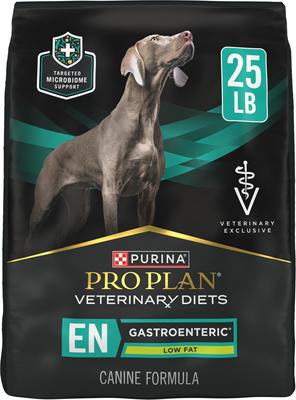
EN Gastroenteric Low Fat Dry Dog Food, 25-lb bag
Purina Pro Plan Veterinary Diets EN Gastroenteric Low Fat Dry Dog Food, 25-lb bag earns a Sniff Score of 28/100 (D) with Fair evidence. 2 controversial ingredients flagged. Primary concern: plant-protein-dominated formula. brewers rice as the #1 ingredient..
Graded by The Sniff System
Quality carbohydrate sources with fermentable fiber.
AAFCO feeding trial substantiation for not stated.
Premium micronutrient forms such as chelated minerals or natural vitamin E.
Plant-protein-dominated formula. brewers rice as the #1 ingredient.
No declared omega-3 source. Fish oil, salmon oil, and algae oil all absent.
Contains menadione. Banned for human OTC use but tolerated at AAFCO-permitted levels in pet food. The only AAFCO-permitted vitamin K source..
Controversial ingredients · 2
- animal digestChemically or enzymatically hydrolyzed animal tissue from unspecified species. Used as a flavor coating. Source quality cannot be verified.
- menadioneSynthetic vitamin K3. Banned in human supplements due to toxicity concerns at high doses. Permitted in pet food but premium brands use natural vitamin K alternatives.
Every flagged ingredient has a published basis (confirmed harm / regulatory action / precautionary). See methodology →
Read why each ingredient is good or bad for dogs.
- 1brewers rice
Broken rice kernels left over from milling, usually destined for human beer-making. Cheaper than whole or even white rice. Same carbs, less nutrition than the brown version.
- 2grainbarley
Whole grain with a low glycemic profile and some soluble fiber. Easy on blood sugar.
- 3corn protein meal
Concentrated corn protein. Similar in role to corn gluten meal, pads the protein number on the label without matching meat amino acids.
- 4protein animalpoultry by-product meal
Unnamed poultry. The mix can include any combination of chicken, turkey, or other birds, with no traceability. Named by-product meals are fine. This one isn't.
- 5protein animalanimal digest Flagged
A liquid flavoring made from hydrolyzed animal tissue, sprayed onto kibble for palatability. Common, not directly harmful, but vague about source.
- 6glycerin
Humectant used in soft-moist foods to keep them chewy. Safe in moderation but a signal of a processed semi-moist product.
- 7animal fat preserved with mixed-tocopherols
- 8mineralcalcium carbonate
Source of calcium. Functional. Required in complete dog foods, especially those without bone-in meat meals.
- 9fiberinulin
Prebiotic fiber that feeds beneficial gut bacteria. Same compound found in chicory root.
- 10mineralpotassium chloride
Required mineral. Sometimes used as a salt substitute. Standard inclusion in complete diets.
- 11mono and dicalcium phosphate
Source of calcium and phosphorus. Standard inclusion in complete dog foods.
- 12sodium bicarbonate
- 13mineralsalt
Sodium chloride. Required at small doses for normal physiology. Not a quality concern in standard amounts.
- 14l-lysine monohydrochloride
Stable form of L-lysine, an essential amino acid. Common in plant-heavy formulas to balance the amino acid profile.
- 15vitaminvitamin e supplement
Required nutrient and a natural antioxidant. Often pulls double duty as a preservative.
- 16mineralzinc proteinate
Zinc bound to protein for better absorption. The premium form of the mineral, versus zinc oxide which sits cheaper on the label.
- 17supplementcholine chloride
Essential nutrient for liver and brain function. Standard inclusion in complete dog foods.
- 18l-ascorbyl-2-polyphosphate
A stable form of vitamin C used in pet food. Provides antioxidant support and survives processing better than plain ascorbic acid.
- 19mineralferrous sulfate
Inorganic iron. Standard mineral source. Iron proteinate is the gentler, better-absorbed premium form.
- 20mineralmanganese proteinate
Manganese bound to protein for better absorption. The chelated form most premium brands use.
- 21vitaminniacin supplement
B vitamin (B3). Required in complete dog foods, added as a supplement to standardize the dose.
- 22vitaminthiamine mononitrate
B vitamin (B1). Essential for nervous system function. Cooked-in vitamin loss is why thiamine is always added back.
- 23vitamincalcium pantothenate
Same as d-calcium pantothenate. Vitamin B5 in standardized form.
- 24vitaminvitamin a supplement
Vitamin A in stable, standardized form. Required for vision, immune function, and growth.
- 25vitaminriboflavin supplement
B vitamin (B2). Required in complete dog foods. The standardized form ensures consistent dosing.
Showing first 25 of 35. Position 1-5 has the largest weight in the recipe.
23 of 25 ingredients have a curated note. Coverage grows over time.