
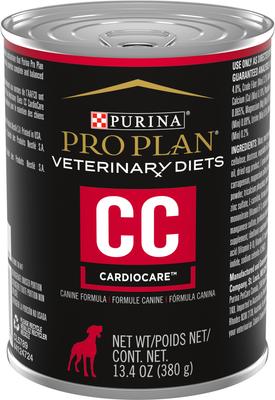
CC Cardiocare Canine Formula Chicken Flavor Canned Dog Food, 13-oz, case of 12
Purina Pro Plan Veterinary Diets CC Cardiocare Canine Formula Chicken Flavor Canned Dog Food, 13-oz, case of 12 earns a Sniff Score of 36/100 (D) with Fair evidence. 4 controversial ingredients flagged. Score capped at 64 due to 4 WATCH ingredients.
Graded by The Sniff System
Quality fat sources: named fat with marine oil (EPA and DHA source).
AAFCO feeding trial substantiation for not stated.
Includes egg, named fish, or organ meat for diverse high-bioavailability protein.
Low protein quality. meat by-products delivers limited bioavailable amino acids.
Contains carrageenan. Plausible rodent colitis mechanism, no direct canine clinical evidence at food-grade levels. Concern elevated for dogs with IBD..
Controversial ingredients · 2
- meat by-productsUnspecified species. AAFCO definition allows organs, blood, bone. but the lack of a named source means quality and consistency are not auditable.
- carrageenanSeaweed-derived thickener; some studies link it to gastrointestinal inflammation. Most common in wet foods but appears in some kibble gravies.
Every flagged ingredient has a published basis (confirmed harm / regulatory action / precautionary). See methodology →
Wet and fresh foods contain more water than kibble (typically 65-78%). On a dry-matter basis, this food's protein content is roughly 27%, comparable to premium kibble (typically 30-45% DMB protein).
Read why each ingredient is good or bad for dogs.
- 1water
Just water. Counted on the label of any wet or fresh food. The number tells you the moisture content.
- 2protein animalmeat by-products Flagged
Unnamed organ meats and tissue. Could be nutritious, but no species is listed, so quality varies by batch.
- 3protein animalchicken
Real meat. Primary protein source, with the amino acid profile dogs actually evolved to eat.
- 4grainrice
Generic rice. Could be white or brown, the label doesn't say. Brown rice would be specified if it were.
- 5fiberpowdered cellulose
Plant fiber, often from wood pulp. Cheap bulk filler. Not harmful, but a tell that the recipe is reaching for inexpensive bulk.
- 6dextrose
- 7vegetable oil
Unnamed plant oil. Could be soy, canola, corn, or a blend. Named oils like sunflower or canola are more transparent.
- 8fatfish oil
Concentrated omega-3s. The reason 'EPA' and 'DHA' get to show up on the bag.
- 9dried egg product
Whole eggs with the water removed. Same nutritional value as fresh eggs, just shelf-stable.
- 10l-lysine monohydrochloride
Stable form of L-lysine, an essential amino acid. Common in plant-heavy formulas to balance the amino acid profile.
- 11glycine
- 12supplementdl-methionine
Essential amino acid. Often added when plant proteins dominate, since methionine is naturally lower in pulses than meat.
- 13othercarrageenan Flagged
Seaweed-derived thickener. Some lab studies suggest gut inflammation, but the evidence in pets is mixed.
- 14mineralmagnesium sulfate
Source of magnesium, a required mineral. Standard inclusion in complete diets.
- 15fiberlocust bean gum
Thickener from carob seed. Generally well-tolerated. Less controversial than carrageenan or guar gum.
- 16mineralpotassium chloride
Required mineral. Sometimes used as a salt substitute. Standard inclusion in complete diets.
- 17garlic powder
- 18mineraltricalcium phosphate
Calcium and phosphorus source. Same role as dicalcium phosphate, slightly different ratio.
- 19supplementtaurine
Amino acid critical for heart health. Especially important in grain-free or pulse-heavy formulas where natural taurine precursors run thin.
- 20vitaminvitamin e supplement
Required nutrient and a natural antioxidant. Often pulls double duty as a preservative.
- 21fiberxanthan gum
Thickener common in wet food and gravies. Same emulsifier-microbiome conversation as guar gum, not a clear flag.
- 22mineralzinc sulfate
Inorganic zinc. Effective at AAFCO doses but less well-absorbed than chelated forms like zinc proteinate.
- 23supplementl-carnitine
Amino acid derivative that helps the body convert fat into energy. Common in weight-management formulas.
- 24mineralferrous sulfate
Inorganic iron. Standard mineral source. Iron proteinate is the gentler, better-absorbed premium form.
- 25vitaminniacin supplement
B vitamin (B3). Required in complete dog foods, added as a supplement to standardize the dose.
Showing first 25 of 38. Position 1-5 has the largest weight in the recipe.
22 of 25 ingredients have a curated note. Coverage grows over time.