
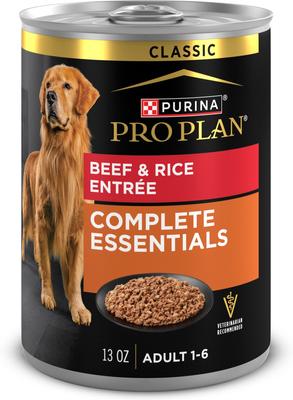
Complete Essentials Beef & Rice Entree Wet Dog Food, 13-oz can, case of 12
Purina Pro Plan Complete Essentials Beef & Rice Entree Wet Dog Food, 13-oz can, case of 12 earns a Sniff Score of 43/100 (D) with Fair evidence. 3 controversial ingredients flagged. Score capped at 64 due to 3 WATCH ingredients.
Graded by The Sniff System
Reasonable protein quality. beef delivers solid amino acid coverage.
AAFCO feeding trial substantiation for not stated.
Includes egg, named fish, or organ meat for diverse high-bioavailability protein.
No declared omega-3 source. Fish oil, salmon oil, and algae oil all absent.
Contains carrageenan. Plausible rodent colitis mechanism, no direct canine clinical evidence at food-grade levels. Concern elevated for dogs with IBD..
Controversial ingredients · 3
- meat by-productsUnspecified species. AAFCO definition allows organs, blood, bone. but the lack of a named source means quality and consistency are not auditable.
- sodium seleniteSynthetic selenium source. Selenium is essential, but sodium selenite has a narrower safety margin than organic alternatives like selenium yeast. Better-formulated foods use the organic form.
- carrageenanSeaweed-derived thickener; some studies link it to gastrointestinal inflammation. Most common in wet foods but appears in some kibble gravies.
Every flagged ingredient has a published basis (confirmed harm / regulatory action / precautionary). See methodology →
Wet and fresh foods contain more water than kibble (typically 65-78%). On a dry-matter basis, this food's protein content is roughly 41%, comparable to premium kibble (typically 30-45% DMB protein).
Read why each ingredient is good or bad for dogs.
- 1protein animalbeef
Real meat. Dense in protein and iron. Some dogs are sensitive to it, but for most it's an excellent base.
- 2water
Just water. Counted on the label of any wet or fresh food. The number tells you the moisture content.
- 3liver
Generic liver, usually chicken or beef. Among the most nutrient-dense ingredients a dog can eat. Named species is more informative.
- 4protein animalmeat by-products Flagged
Unnamed organ meats and tissue. Could be nutritious, but no species is listed, so quality varies by batch.
- 5protein animalchicken
Real meat. Primary protein source, with the amino acid profile dogs actually evolved to eat.
- 6grainrice
Generic rice. Could be white or brown, the label doesn't say. Brown rice would be specified if it were.
- 7fish
- 8mineralpotassium chloride
Required mineral. Sometimes used as a salt substitute. Standard inclusion in complete diets.
- 9mineralzinc sulfate
Inorganic zinc. Effective at AAFCO doses but less well-absorbed than chelated forms like zinc proteinate.
- 10mineralferrous sulfate
Inorganic iron. Standard mineral source. Iron proteinate is the gentler, better-absorbed premium form.
- 11mineralcopper sulfate
Inorganic copper. Standard, effective at small doses. Premium formulas tend to use copper proteinate instead.
- 12mineralmanganese sulfate
Inorganic manganese. Functional but less well-absorbed than the chelated proteinate form.
- 13mineralpotassium iodide
Source of iodine, an essential trace mineral for thyroid function. Required for AAFCO-complete formulas.
- 14mineralsodium selenite Flagged
Inorganic selenium. Effective at AAFCO levels, no documented safety concern in dogs despite what some pet food blogs claim. Selenium yeast is a marginal upgrade, not a necessity. See why →
- 15fiberguar gum
Thickener common in wet food. Emerging research on emulsifiers and the gut microbiome, but no smoking gun in dogs yet.
- 16mineralsalt
Sodium chloride. Required at small doses for normal physiology. Not a quality concern in standard amounts.
- 17othercarrageenan Flagged
Seaweed-derived thickener. Some lab studies suggest gut inflammation, but the evidence in pets is mixed.
- 18vitaminvitamin e supplement
Required nutrient and a natural antioxidant. Often pulls double duty as a preservative.
- 19vitaminniacin supplement
B vitamin (B3). Required in complete dog foods, added as a supplement to standardize the dose.
- 20vitaminthiamine mononitrate
B vitamin (B1). Essential for nervous system function. Cooked-in vitamin loss is why thiamine is always added back.
- 21vitamincalcium pantothenate
Same as d-calcium pantothenate. Vitamin B5 in standardized form.
- 22vitaminpyridoxine hydrochloride
B vitamin (B6). Essential for protein metabolism. Standard inclusion in complete formulas.
- 23vitamin b-12 supplement
- 24vitaminriboflavin supplement
B vitamin (B2). Required in complete dog foods. The standardized form ensures consistent dosing.
- 25vitaminvitamin a supplement
Vitamin A in stable, standardized form. Required for vision, immune function, and growth.
Showing first 25 of 29. Position 1-5 has the largest weight in the recipe.
23 of 25 ingredients have a curated note. Coverage grows over time.