
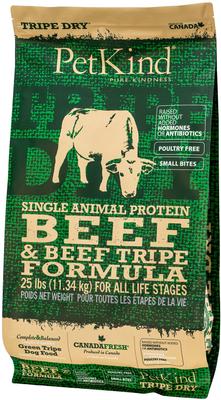
Beef Tripe Dry Dog Food, 25-lb bag
PetKind Beef Tripe Dry Dog Food, 25-lb bag earns a Sniff Score of 54/100 (C) with Fair evidence. 1 controversial ingredient flagged. Score capped at 59 due to no AAFCO statement.
Graded by The Sniff System
Quality fat sources: named fat with marine oil (EPA and DHA source).
Includes egg, named fish, or organ meat for diverse high-bioavailability protein.
No AAFCO statement. Nutritional completeness unverified.
Contains high legume stacking. Multiple pulse-family ingredients in top 15. Mitigated by taurine supplementation or organ meat (natural taurine precursor) in top 10..
Controversial ingredients · 1
- sodium seleniteSynthetic selenium source. Selenium is essential, but sodium selenite has a narrower safety margin than organic alternatives like selenium yeast. Better-formulated foods use the organic form.
Every flagged ingredient has a published basis (confirmed harm / regulatory action / precautionary). See methodology →
Read why each ingredient is good or bad for dogs.
- 1beef tripe
Stomach lining. Strong-smelling but nutrient-dense, with natural digestive enzymes.
- 2protein animalbeef
Real meat. Dense in protein and iron. Some dogs are sensitive to it, but for most it's an excellent base.
- 3legumelentils
Same concern as peas. Affordable plant protein, but when they pile up in the top 5 ingredients, it's a flag. See why →
- 4legumepeas
Cheap protein bulk. Fine in small amounts, but when peas stack with lentils and chickpeas in the top ingredients, it's the pattern the FDA flagged in its heart-disease investigation. See why →
- 5protein plantpea protein
Concentrated plant protein. Inflates the protein number on the label without matching the amino acid quality of meat.
- 6legumechickpeas
Also called garbanzo beans. Affordable plant protein source, part of the legume stack the FDA examined in its heart-disease investigation. See why →
- 7pea starch
Refined starch from peas, mostly carbs after the protein is removed. Counts toward the legume stack the FDA examined.
- 8fatflaxseed
Plant source of omega-3. Helpful for skin and coat, though dogs absorb omega-3 from fish more efficiently.
- 9fatcanola oil
Plant oil. Some omega-3 from the parent plant, though dogs absorb it less efficiently than fish-derived omega-3. Fine in moderation.
- 10vegetablepumpkin
Soluble fiber that supports stool quality. Mild and well-tolerated.
- 11vegetablespinach
Leafy green. Some iron, vitamin K, and fiber. The dose in kibble is small but it's real food.
- 12carrot
Real vegetable. Fiber, beta-carotene, antioxidants. Same as carrots, sometimes singular on labels.
- 13vegetablebroccoli
Real vegetable. Adds fiber and some antioxidants. Fine in the small amounts used in kibble.
- 14cranberry
Same as cranberries. Real ingredient, dose in kibble is small.
- 15apple
Real fruit, some fiber and antioxidants. The amount in kibble is too small to matter much.
- 16blueberry
- 17banana
- 18fatfish oil
Concentrated omega-3s. The reason 'EPA' and 'DHA' get to show up on the bag.
- 19othernatural flavor
Legal term for animal-derived flavoring, usually hydrolyzed liver or broth. Adds taste, says nothing about quality.
- 20mineralzinc proteinate
Zinc bound to protein for better absorption. The premium form of the mineral, versus zinc oxide which sits cheaper on the label.
- 21mineraliron proteinate
Iron bound to protein for better absorption. The premium form versus inorganic iron sulfate.
- 22mineralcopper proteinate
Copper bound to protein for better absorption. Common in better-formulated diets.
- 23mineralmanganese proteinate
Manganese bound to protein for better absorption. The chelated form most premium brands use.
- 24vitaminvitamin a supplement
Vitamin A in stable, standardized form. Required for vision, immune function, and growth.
- 25vitaminvitamin d3 supplement
The active form of vitamin D dogs need. Required for calcium absorption and bone health.
Showing first 25 of 50. Position 1-5 has the largest weight in the recipe.
23 of 25 ingredients have a curated note. Coverage grows over time.