
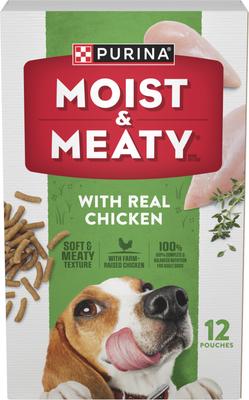
Real Chicken Recipe Soft Dry Dog Food, 6-oz pouch, case of 12
Moist & Meaty Real Chicken Recipe Soft Dry Dog Food, 6-oz pouch, case of 12 earns a Sniff Score of 0/100 (F) with Fair evidence. 4 controversial ingredients flagged. Score capped at 39 due to 3 FLAG ingredients.
Graded by The Sniff System
Controversial ingredients · 6
- high fructose corn syrupAdded sugar. No nutritional purpose in dog food; commonly added to semi-moist treats for palatability.
- corn syrupAdded sugar. No nutritional purpose in dog food; commonly added to semi-moist treats for palatability.
- sodium seleniteSynthetic selenium source. Selenium is essential, but sodium selenite has a narrower safety margin than organic alternatives like selenium yeast. Better-formulated foods use the organic form.
- ethoxyquinSynthetic antioxidant originally developed as a rubber stabilizer. The FDA asked manufacturers to voluntarily reduce levels in 1997. Often present in fish meal without being declared on the label.
- yellow 5Artificial color with no nutritional value. Some dogs show allergic-type reactions.
- red 40Artificial color with no nutritional value. Linked to behavioral effects in children; relevance to dogs is unclear but the ingredient serves only marketing purposes.
Every flagged ingredient has a published basis (confirmed harm / regulatory action / precautionary). See methodology →
Wet and fresh foods contain more water than kibble (typically 65-78%). On a dry-matter basis, this food's protein content is roughly 27%, comparable to premium kibble (typically 30-45% DMB protein).
Read why each ingredient is good or bad for dogs.
- 1protein animalchicken
Real meat. Primary protein source, with the amino acid profile dogs actually evolved to eat.
- 2soy flour
Refined soy. Cheap plant protein, common in budget formulas. Pads the protein percent without matching meat amino acids.
- 3soy grits
- 4high fructose corn syrup Flagged
- 5wheat flour
Refined wheat, usually used as a binder. Cheap, not harmful, not a nutrition contributor.
- 6water
Just water. Counted on the label of any wet or fresh food. The number tells you the moisture content.
- 7animal fat preserved with mixed-tocopherols
- 8othercorn syrup Flagged
Added sugar, usually for palatability or moisture. Dogs don't need added sugar. Common in semi-moist treats.
- 9phosphoric acid
- 10mineralcalcium carbonate
Source of calcium. Functional. Required in complete dog foods, especially those without bone-in meat meals.
- 11mineralsalt
Sodium chloride. Required at small doses for normal physiology. Not a quality concern in standard amounts.
- 12sorbic acid
- 13calcium propionate
- 14vegetable oil
Unnamed plant oil. Could be soy, canola, corn, or a blend. Named oils like sunflower or canola are more transparent.
- 15mineralzinc sulfate
Inorganic zinc. Effective at AAFCO doses but less well-absorbed than chelated forms like zinc proteinate.
- 16mineralferrous sulfate
Inorganic iron. Standard mineral source. Iron proteinate is the gentler, better-absorbed premium form.
- 17mineralmanganese sulfate
Inorganic manganese. Functional but less well-absorbed than the chelated proteinate form.
- 18mineralcopper sulfate
Inorganic copper. Standard, effective at small doses. Premium formulas tend to use copper proteinate instead.
- 19mineralcalcium iodate
Source of iodine for thyroid function. Functional, required in complete formulas.
- 20mineralsodium selenite Flagged
Inorganic selenium. Effective at AAFCO levels, no documented safety concern in dogs despite what some pet food blogs claim. Selenium yeast is a marginal upgrade, not a necessity. See why →
- 21supplementdl-methionine
Essential amino acid. Often added when plant proteins dominate, since methionine is naturally lower in pulses than meat.
- 22supplementcholine chloride
Essential nutrient for liver and brain function. Standard inclusion in complete dog foods.
- 23preservative syntheticethoxyquin Flagged
Synthetic preservative originally developed as a herbicide. Common in fish meal, sometimes not on the label because suppliers add it before delivery. Banned in human food.
- 24otheryellow 5 Flagged
Artificial coloring. Strictly cosmetic. Banned or restricted in several countries.
- 25otherred 40 Flagged
Artificial coloring. Dogs don't care about color. Banned in several countries over hyperactivity and allergic-reaction concerns.
Showing first 25 of 26. Position 1-5 has the largest weight in the recipe.
19 of 25 ingredients have a curated note. Coverage grows over time.