
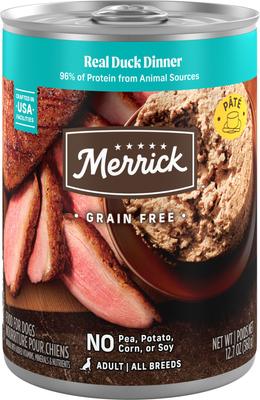
Grain-Free Real Duck Dinner Canned Dog Food, 12.7-oz can, case of 12
Merrick Grain-Free Real Duck Dinner Canned Dog Food, 12.7-oz can, case of 12 earns a Sniff Score of 59/100 (C) with Fair evidence. 1 controversial ingredient flagged. Primary concern: contains guar gum. emerging microbiome data on emulsifiers; no canine clinical evidence. minor penalty in canned food...
Graded by The Sniff System
Reasonable protein quality. duck delivers solid amino acid coverage.
Quality fat sources: named fat with marine oil (EPA and DHA source).
Includes egg, named fish, or organ meat for diverse high-bioavailability protein.
Contains guar gum. Emerging microbiome data on emulsifiers; no canine clinical evidence. Minor penalty in canned food..
Wet and fresh foods contain more water than kibble (typically 65-78%). On a dry-matter basis, this food's protein content is roughly 36%, comparable to premium kibble (typically 30-45% DMB protein).
Read why each ingredient is good or bad for dogs.
- 1protein animalduck
Real meat. Often used as a novel protein for dogs with sensitivities to chicken or beef.
- 2protein animalduck liver
- 3turkey broth
Real broth from named meat. Adds flavor and moisture, signals a recipe that leans on real meat.
- 4protein animalchicken
Real meat. Primary protein source, with the amino acid profile dogs actually evolved to eat.
- 5dried egg product
Whole eggs with the water removed. Same nutritional value as fresh eggs, just shelf-stable.
- 6othernatural flavor
Legal term for animal-derived flavoring, usually hydrolyzed liver or broth. Adds taste, says nothing about quality.
- 7mineraltricalcium phosphate
Calcium and phosphorus source. Same role as dicalcium phosphate, slightly different ratio.
- 8fatsalmon oil
Pure omega-3s. The thing skin-and-coat formulas are usually built around.
- 9mineralsalt
Sodium chloride. Required at small doses for normal physiology. Not a quality concern in standard amounts.
- 10fiberlocust bean gum
Thickener from carob seed. Generally well-tolerated. Less controversial than carrageenan or guar gum.
- 11fiberguar gum
Thickener common in wet food. Emerging research on emulsifiers and the gut microbiome, but no smoking gun in dogs yet.
- 12supplementcholine chloride
Essential nutrient for liver and brain function. Standard inclusion in complete dog foods.
- 13mineralpotassium chloride
Required mineral. Sometimes used as a salt substitute. Standard inclusion in complete diets.
- 14mineralcalcium carbonate
Source of calcium. Functional. Required in complete dog foods, especially those without bone-in meat meals.
- 15supplementtaurine
Amino acid critical for heart health. Especially important in grain-free or pulse-heavy formulas where natural taurine precursors run thin.
- 16vitaminvitamin e supplement
Required nutrient and a natural antioxidant. Often pulls double duty as a preservative.
- 17vitaminniacin supplement
B vitamin (B3). Required in complete dog foods, added as a supplement to standardize the dose.
- 18vitaminthiamine mononitrate
B vitamin (B1). Essential for nervous system function. Cooked-in vitamin loss is why thiamine is always added back.
- 19vitamincalcium pantothenate
Same as d-calcium pantothenate. Vitamin B5 in standardized form.
- 20vitaminpyridoxine hydrochloride
B vitamin (B6). Essential for protein metabolism. Standard inclusion in complete formulas.
- 21vitamin b-12 supplement
- 22vitaminriboflavin supplement
B vitamin (B2). Required in complete dog foods. The standardized form ensures consistent dosing.
- 23vitaminvitamin a supplement
Vitamin A in stable, standardized form. Required for vision, immune function, and growth.
- 24vitaminfolic acid
B vitamin (B9), essential for cell function. Standard in complete dog foods.
- 25vitamin d-3 supplement
Showing first 25 of 26. Position 1-5 has the largest weight in the recipe.
22 of 25 ingredients have a curated note. Coverage grows over time.