
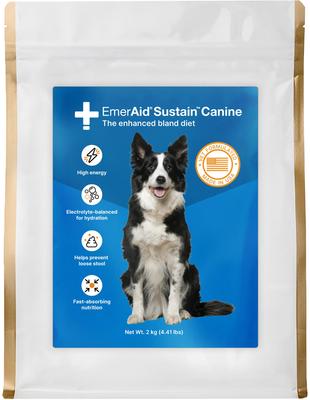
EmerAid Sustain Canine Recovery Food, 4.4-lb bag
Lafeber EmerAid Sustain Canine Recovery Food, 4.4-lb bag earns a Sniff Score of 49/100 (C) with Fair evidence. 1 controversial ingredient flagged. Score capped at 59 due to no AAFCO statement.
Graded by The Sniff System
Strong protein profile with cooked chicken as the primary ingredient, delivering high biological value.
Includes egg, named fish, or organ meat for diverse high-bioavailability protein.
No AAFCO statement. Nutritional completeness unverified.
Contains added sugar. Nutritionally unjustifiable in any complete dog diet..
Controversial ingredients · 1
- sodium seleniteSynthetic selenium source. Selenium is essential, but sodium selenite has a narrower safety margin than organic alternatives like selenium yeast. Better-formulated foods use the organic form.
Every flagged ingredient has a published basis (confirmed harm / regulatory action / precautionary). See methodology →
Read why each ingredient is good or bad for dogs.
- 1cooked chicken
- 2potato starch
Refined potato. Pure carb energy, low on other nutrition. Often used as a binder in grain-free recipes.
- 3dried hydrolyzed casein
- 4grainground rice
Cracked rice for binding and texture. Fine but unremarkable as a nutrient source.
- 5hydrolyzed soy protein
- 6glucose syrup solids
- 7dried chicken liver
Organ meat. Dense in protein, iron, vitamin A, and the B vitamins. Among the most nutrient-rich ingredients a dog can eat.
- 8protein animaldried egg
Whole eggs. The highest-quality protein on any ingredient label, by amino acid score.
- 9corn oil
- 10fatcanola oil
Plant oil. Some omega-3 from the parent plant, though dogs absorb it less efficiently than fish-derived omega-3. Fine in moderation.
- 11mineraldicalcium phosphate
Calcium and phosphorus combined. Required source of both minerals, especially in formulas without much bone content.
- 12defatted wheat germ
- 13fibercellulose
- 14mineralpotassium chloride
Required mineral. Sometimes used as a salt substitute. Standard inclusion in complete diets.
- 15ground limestone
- 16mineralsalt
Sodium chloride. Required at small doses for normal physiology. Not a quality concern in standard amounts.
- 17dextrose
- 18supplementcholine chloride
Essential nutrient for liver and brain function. Standard inclusion in complete dog foods.
- 19supplementdl-methionine
Essential amino acid. Often added when plant proteins dominate, since methionine is naturally lower in pulses than meat.
- 20preservative naturalcitric acid
Natural antioxidant preservative. Helps keep fats from going rancid.
- 21supplementl-lysine
Essential amino acid. Plant-protein-heavy formulas sometimes add it to round out the amino acid profile.
- 22mineralmagnesium sulfate
Source of magnesium, a required mineral. Standard inclusion in complete diets.
- 23supplementtaurine
Amino acid critical for heart health. Especially important in grain-free or pulse-heavy formulas where natural taurine precursors run thin.
- 24vitaminvitamin e supplement
Required nutrient and a natural antioxidant. Often pulls double duty as a preservative.
- 25zinc oxide
Inorganic zinc. Cheapest mineral form on the market. Functional but less bioavailable than chelated alternatives.
Showing first 25 of 41. Position 1-5 has the largest weight in the recipe.
16 of 25 ingredients have a curated note. Coverage grows over time.