
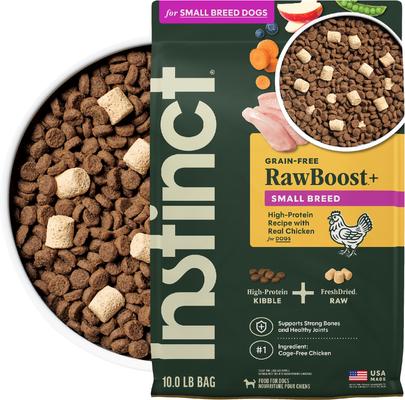
RawBoost Small Breed High Protein Real Chicken Recipe Dry Dog Food, 10-lb bag
Instinct RawBoost Small Breed High Protein Real Chicken Recipe Dry Dog Food, 10-lb bag earns a Sniff Score of 72/100 (B) with Fair evidence. Zero controversial ingredients flagged. Strong protein profile with chicken as the primary ingredient, delivering high biological value..
Graded by The Sniff System
Strong protein profile with chicken as the primary ingredient, delivering high biological value.
Quality fat sources: named fat with marine oil (EPA and DHA source).
Named fresh meat paired with same-species meal, a strong extrusion architecture.
Controversial ingredients · 1
- sodium seleniteSynthetic selenium source. Selenium is essential, but sodium selenite has a narrower safety margin than organic alternatives like selenium yeast. Better-formulated foods use the organic form.
Every flagged ingredient has a published basis (confirmed harm / regulatory action / precautionary). See methodology →
Read why each ingredient is good or bad for dogs.
- 1protein animalchicken
Real meat. Primary protein source, with the amino acid profile dogs actually evolved to eat.
- 2protein animalchicken meal
Chicken with the water cooked out. Per pound, packs more protein than fresh chicken.
- 3legumepeas
Cheap protein bulk. Fine in small amounts, but when peas stack with lentils and chickpeas in the top ingredients, it's the pattern the FDA flagged in its heart-disease investigation. See why →
- 4fatchicken fat
Despite the name, a high-quality energy source. Concentrated calories plus essential fatty acids like linoleic acid.
- 5tapioca
Starch from cassava root. Highly digestible energy source, but pure starch with minimal nutrition beyond that.
- 6vegetablesweet potato
Complex carb with fiber and beta-carotene. Gentle on the stomach.
- 7protein animalfish meal
Concentrated fish protein, usually whitefish, herring, or mackerel. Strong amino acid profile.
- 8protein animalturkey meal
Turkey with the water cooked out. Per pound, packs more protein than fresh turkey.
- 9freeze-dried chicken
- 10legumechickpeas
Also called garbanzo beans. Affordable plant protein source, part of the legume stack the FDA examined in its heart-disease investigation. See why →
- 11dried tomato pomace
The fiber-rich byproduct of tomato processing. Sometimes flagged unfairly. It's a real fiber source, not a filler shortcut.
- 12othernatural flavor
Legal term for animal-derived flavoring, usually hydrolyzed liver or broth. Adds taste, says nothing about quality.
- 13ground flaxseeds
Plural form, same as flaxseed. Plant source of omega-3, helpful for skin and coat.
- 14freeze-dried chicken liver
- 15mineralsalt
Sodium chloride. Required at small doses for normal physiology. Not a quality concern in standard amounts.
- 16fatcoconut oil
Saturated fat with medium-chain triglycerides. Mostly marketing in the doses kibble uses, but harmless.
- 17mineralpotassium chloride
Required mineral. Sometimes used as a salt substitute. Standard inclusion in complete diets.
- 18pumpkin seeds
- 19freeze-dried chicken heart
- 20montmorillonite clay
Natural clay used as a binder and anti-caking agent. Functional, not nutritional.
- 21fibermiscanthus grass
Perennial grass used as a fiber source. Replaces cellulose in some recipes. Functional but unremarkable.
- 22vitaminvitamin e supplement
Required nutrient and a natural antioxidant. Often pulls double duty as a preservative.
- 23vitaminvitamin a supplement
Vitamin A in stable, standardized form. Required for vision, immune function, and growth.
- 24vitaminniacin supplement
B vitamin (B3). Required in complete dog foods, added as a supplement to standardize the dose.
- 25vitaminthiamine mononitrate
B vitamin (B1). Essential for nervous system function. Cooked-in vitamin loss is why thiamine is always added back.
Showing first 25 of 53. Position 1-5 has the largest weight in the recipe.
21 of 25 ingredients have a curated note. Coverage grows over time.