
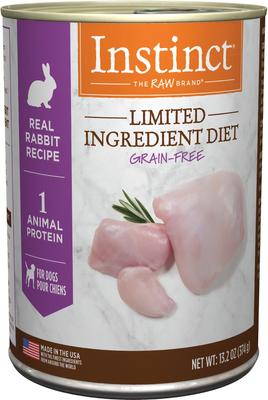
Limited Ingredient Diet Adult Grain-Free Real Rabbit Recipe Wet Dog Food, 13.2-oz can, case of 6
Instinct Limited Ingredient Diet Adult Grain-Free Real Rabbit Recipe Wet Dog Food, 13.2-oz can, case of 6 earns a Sniff Score of 47/100 (C) with Fair evidence. Zero controversial ingredients flagged. Primary concern: no declared omega-3 source. fish oil, salmon oil, and algae oil all absent..
Graded by The Sniff System
Includes egg, named fish, or organ meat for diverse high-bioavailability protein.
AAFCO formulation inferred from declared adult maintenance. Verbatim statement not published by retailer.
No declared omega-3 source. Fish oil, salmon oil, and algae oil all absent.
Controversial ingredients · 1
- sodium seleniteSynthetic selenium source. Selenium is essential, but sodium selenite has a narrower safety margin than organic alternatives like selenium yeast. Better-formulated foods use the organic form.
Every flagged ingredient has a published basis (confirmed harm / regulatory action / precautionary). See methodology →
Wet and fresh foods contain more water than kibble (typically 65-78%). On a dry-matter basis, this food's protein content is roughly 45%, comparable to premium kibble (typically 30-45% DMB protein).
Read why each ingredient is good or bad for dogs.
- 1rabbit
Real meat, very lean. A common novel protein for elimination diets.
- 2water
Just water. Counted on the label of any wet or fresh food. The number tells you the moisture content.
- 3rabbit liver
- 4legumechickpeas
Also called garbanzo beans. Affordable plant protein source, part of the legume stack the FDA examined in its heart-disease investigation. See why →
- 5montmorillonite clay
Natural clay used as a binder and anti-caking agent. Functional, not nutritional.
- 6mineralpotassium chloride
Required mineral. Sometimes used as a salt substitute. Standard inclusion in complete diets.
- 7mineralsalt
Sodium chloride. Required at small doses for normal physiology. Not a quality concern in standard amounts.
- 8mineralzinc proteinate
Zinc bound to protein for better absorption. The premium form of the mineral, versus zinc oxide which sits cheaper on the label.
- 9mineraliron proteinate
Iron bound to protein for better absorption. The premium form versus inorganic iron sulfate.
- 10mineralcopper proteinate
Copper bound to protein for better absorption. Common in better-formulated diets.
- 11mineralmanganese proteinate
Manganese bound to protein for better absorption. The chelated form most premium brands use.
- 12mineralsodium selenite Flagged
Inorganic selenium. Effective at AAFCO levels, no documented safety concern in dogs despite what some pet food blogs claim. Selenium yeast is a marginal upgrade, not a necessity. See why →
- 13cobalt proteinate
Cobalt bound to protein. Trace mineral needed for vitamin B12 synthesis, chelated form for better absorption.
- 14mineralpotassium iodide
Source of iodine, an essential trace mineral for thyroid function. Required for AAFCO-complete formulas.
- 15supplementcholine chloride
Essential nutrient for liver and brain function. Standard inclusion in complete dog foods.
- 16vitaminvitamin e supplement
Required nutrient and a natural antioxidant. Often pulls double duty as a preservative.
- 17vitaminthiamine mononitrate
B vitamin (B1). Essential for nervous system function. Cooked-in vitamin loss is why thiamine is always added back.
- 18vitaminniacin supplement
B vitamin (B3). Required in complete dog foods, added as a supplement to standardize the dose.
- 19vitamind-calcium pantothenate
B vitamin (B5). Standard inclusion in complete dog foods.
- 20vitaminvitamin a supplement
Vitamin A in stable, standardized form. Required for vision, immune function, and growth.
- 21vitaminriboflavin supplement
B vitamin (B2). Required in complete dog foods. The standardized form ensures consistent dosing.
- 22vitaminbiotin
B vitamin that supports skin and coat health. Required for AAFCO-complete formulas.
- 23vitaminvitamin b12 supplement
Essential for red blood cell formation and neurological function. Plant ingredients lack B12, so it has to be added.
- 24vitaminpyridoxine hydrochloride
B vitamin (B6). Essential for protein metabolism. Standard inclusion in complete formulas.
- 25vitaminvitamin d3 supplement
The active form of vitamin D dogs need. Required for calcium absorption and bone health.
Showing first 25 of 27. Position 1-5 has the largest weight in the recipe.
24 of 25 ingredients have a curated note. Coverage grows over time.