
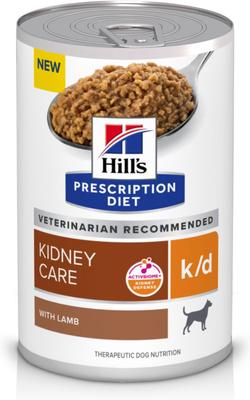
k/d Kidney Care with Lamb Wet Dog Food, 13-oz can, case of 12
Hill's Prescription Diet k/d Kidney Care with Lamb Wet Dog Food, 13-oz can, case of 12 earns a Sniff Score of 49/100 (C) with Fair evidence. 1 controversial ingredient flagged. Score capped at 49 due to CP_DM=16.1%, CF_DM=26.3%.
Graded by The Sniff System
Reasonable protein quality. pork liver delivers solid amino acid coverage.
Quality fat sources: named fat with marine oil (EPA and DHA source).
AAFCO feeding trial substantiation for not stated.
Contains added sugar. Nutritionally unjustifiable in any complete dog diet..
Wet and fresh foods contain more water than kibble (typically 65-78%). On a dry-matter basis, this food's protein content is roughly 16%, comparable to premium kibble (typically 30-45% DMB protein).
Read why each ingredient is good or bad for dogs.
- 1water
Just water. Counted on the label of any wet or fresh food. The number tells you the moisture content.
- 2protein animalpork liver
Organ meat. Dense in B vitamins, iron, and vitamin A. Among the most nutritious ingredients on any label.
- 3corn starch
- 4protein animallamb
Real meat. Often used for dogs with chicken or beef sensitivities. Slightly higher fat content than chicken.
- 5fatchicken fat
Despite the name, a high-quality energy source. Concentrated calories plus essential fatty acids like linoleic acid.
- 6dextrose
- 7fatflaxseed
Plant source of omega-3. Helpful for skin and coat, though dogs absorb omega-3 from fish more efficiently.
- 8fiberdried beet pulp
Soluble fiber from sugar-beet processing. Sometimes treated as a filler, but it's actually one of the better fiber sources in kibble.
- 9chicken liver flavor
Hydrolyzed chicken liver used as a flavor enhancer. Real ingredient, used in tiny amounts for palatability.
- 10fatfish oil
Concentrated omega-3s. The reason 'EPA' and 'DHA' get to show up on the bag.
- 11fiberpowdered cellulose
Plant fiber, often from wood pulp. Cheap bulk filler. Not harmful, but a tell that the recipe is reaching for inexpensive bulk.
- 12mineralcalcium carbonate
Source of calcium. Functional. Required in complete dog foods, especially those without bone-in meat meals.
- 13potassium citrate
Source of potassium. Sometimes added in urinary-support formulas to help manage urine pH.
- 14supplementl-lysine
Essential amino acid. Plant-protein-heavy formulas sometimes add it to round out the amino acid profile.
- 15mineralpotassium chloride
Required mineral. Sometimes used as a salt substitute. Standard inclusion in complete diets.
- 16betaine
- 17supplementdl-methionine
Essential amino acid. Often added when plant proteins dominate, since methionine is naturally lower in pulses than meat.
- 18grainoats
Whole grain. Steady energy, soluble fiber, and well-tolerated by most dogs.
- 19fiberfructooligosaccharides
Prebiotic fiber, often called FOS. Feeds beneficial gut bacteria, similar in function to inulin.
- 20supplementcholine chloride
Essential nutrient for liver and brain function. Standard inclusion in complete dog foods.
- 21mineralmagnesium oxide
Inorganic magnesium. Functional at AAFCO doses, less efficiently absorbed than chelated forms.
- 22mineralferrous sulfate
Inorganic iron. Standard mineral source. Iron proteinate is the gentler, better-absorbed premium form.
- 23zinc oxide
Inorganic zinc. Cheapest mineral form on the market. Functional but less bioavailable than chelated alternatives.
- 24mineralmanganese sulfate
Inorganic manganese. Functional but less well-absorbed than the chelated proteinate form.
- 25mineralcopper sulfate
Inorganic copper. Standard, effective at small doses. Premium formulas tend to use copper proteinate instead.
Showing first 25 of 33. Position 1-5 has the largest weight in the recipe.
22 of 25 ingredients have a curated note. Coverage grows over time.