
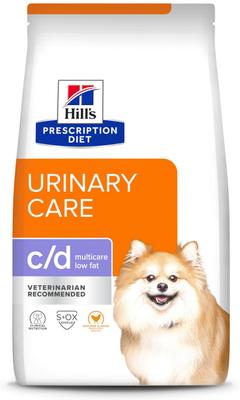
c/d Multicare Low Fat Adult Urinary Care Chicken Flavored Dry Dog Food, 8.5-lb bag
Hill's Prescription Diet c/d Multicare Low Fat Adult Urinary Care Chicken Flavored Dry Dog Food, 8.5-lb bag earns a Sniff Score of 49/100 (C) with Fair evidence. Zero controversial ingredients flagged. Score capped at 49 due to CP_DM=19.4%, CF_DM=5.0%.
Graded by The Sniff System
Quality carbohydrate sources with declared fiber.
Quality fat sources: named fat with marine oil (EPA and DHA source).
AAFCO feeding trial substantiation for adult maintenance.
Controversial ingredients · 1
- sodium seleniteSynthetic selenium source. Selenium is essential, but sodium selenite has a narrower safety margin than organic alternatives like selenium yeast. Better-formulated foods use the organic form.
Every flagged ingredient has a published basis (confirmed harm / regulatory action / precautionary). See methodology →
Read why each ingredient is good or bad for dogs.
- 1brewers rice
Broken rice kernels left over from milling, usually destined for human beer-making. Cheaper than whole or even white rice. Same carbs, less nutrition than the brown version.
- 2cracked pearled barley
Pre-cracked pearled barley for better digestibility. Same whole-grain story.
- 3grainwhole grain corn
Whole corn with the kernel intact. Decent fiber and B vitamins, though it can crowd out meat in cheaper recipes.
- 4corn protein meal
Concentrated corn protein. Similar in role to corn gluten meal, pads the protein number on the label without matching meat amino acids.
- 5protein animalchicken meal
Chicken with the water cooked out. Per pound, packs more protein than fresh chicken.
- 6hydrolyzed chicken flavor
Hydrolyzed chicken used as a palatability enhancer. Real ingredient, tiny inclusion, no quality signal either way.
- 7fatchicken fat
Despite the name, a high-quality energy source. Concentrated calories plus essential fatty acids like linoleic acid.
- 8pork liver flavor
Hydrolyzed pork liver used as a flavor enhancer. Same role as chicken liver flavor.
- 9lactic acid
Natural acid used as a mild preservative and pH adjuster. Found in fermented foods too. Safe at typical inclusion.
- 10protein animalegg product
Processed whole eggs. Same nutritional profile as fresh eggs, just shelf-stable.
- 11fish flavor
- 12fatflaxseed
Plant source of omega-3. Helpful for skin and coat, though dogs absorb omega-3 from fish more efficiently.
- 13fatfish oil
Concentrated omega-3s. The reason 'EPA' and 'DHA' get to show up on the bag.
- 14calcium sulfate
Source of calcium. Functional, required for AAFCO-complete formulas.
- 15glyceryl monostearate
- 16mineralpotassium chloride
Required mineral. Sometimes used as a salt substitute. Standard inclusion in complete diets.
- 17potassium citrate
Source of potassium. Sometimes added in urinary-support formulas to help manage urine pH.
- 18mineralsalt
Sodium chloride. Required at small doses for normal physiology. Not a quality concern in standard amounts.
- 19supplementcholine chloride
Essential nutrient for liver and brain function. Standard inclusion in complete dog foods.
- 20supplementl-lysine
Essential amino acid. Plant-protein-heavy formulas sometimes add it to round out the amino acid profile.
- 21vitaminvitamin e supplement
Required nutrient and a natural antioxidant. Often pulls double duty as a preservative.
- 22vitaminniacin supplement
B vitamin (B3). Required in complete dog foods, added as a supplement to standardize the dose.
- 23vitaminthiamine mononitrate
B vitamin (B1). Essential for nervous system function. Cooked-in vitamin loss is why thiamine is always added back.
- 24vitaminvitamin a supplement
Vitamin A in stable, standardized form. Required for vision, immune function, and growth.
- 25vitamincalcium pantothenate
Same as d-calcium pantothenate. Vitamin B5 in standardized form.
Showing first 25 of 44. Position 1-5 has the largest weight in the recipe.
23 of 25 ingredients have a curated note. Coverage grows over time.