
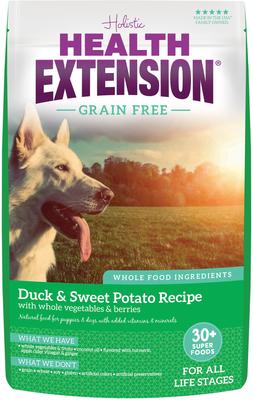
Grain-Free Duck & Sweet Potato Recipe Dry Dog Food, 23.5-lb bag
Health Extension Grain-Free Duck & Sweet Potato Recipe Dry Dog Food, 23.5-lb bag earns a Sniff Score of 59/100 (C) with Fair evidence. 1 controversial ingredient flagged. Score capped at 59 due to no AAFCO statement.
Graded by The Sniff System
Strong protein profile with duck as the primary ingredient, delivering high biological value.
Named fresh meat paired with same-species meal, a strong extrusion architecture.
Includes egg, named fish, or organ meat for diverse high-bioavailability protein.
No AAFCO statement. Nutritional completeness unverified.
Contains high legume stacking. Multiple pulse-family ingredients in top 15. Mitigated by taurine supplementation or organ meat (natural taurine precursor) in top 10..
Controversial ingredients · 1
- sodium seleniteSynthetic selenium source. Selenium is essential, but sodium selenite has a narrower safety margin than organic alternatives like selenium yeast. Better-formulated foods use the organic form.
Every flagged ingredient has a published basis (confirmed harm / regulatory action / precautionary). See methodology →
Read why each ingredient is good or bad for dogs.
- 1protein animalduck
Real meat. Often used as a novel protein for dogs with sensitivities to chicken or beef.
- 2protein animalduck meal
Duck cooked into a dry concentrate. Per pound, more protein than fresh duck.
- 3vegetablesweet potato
Complex carb with fiber and beta-carotene. Gentle on the stomach.
- 4legumechickpeas
Also called garbanzo beans. Affordable plant protein source, part of the legume stack the FDA examined in its heart-disease investigation. See why →
- 5protein animalwhitefish meal
Whitefish cooked into a dry concentrate. Strong protein source, common in premium formulas.
- 6legumelentils
Same concern as peas. Affordable plant protein, but when they pile up in the top 5 ingredients, it's a flag. See why →
- 7legumepeas
Cheap protein bulk. Fine in small amounts, but when peas stack with lentils and chickpeas in the top ingredients, it's the pattern the FDA flagged in its heart-disease investigation. See why →
- 8fatsunflower oil
Common plant oil. Useful in moderation for omega-6, though too much skews the omega ratio against the dog's favor.
- 9tapioca starch
Refined cassava starch, used as a binder. Easy to digest, low on nutrition.
- 10fiberdried beet pulp
Soluble fiber from sugar-beet processing. Sometimes treated as a filler, but it's actually one of the better fiber sources in kibble.
- 11fatcoconut oil
Saturated fat with medium-chain triglycerides. Mostly marketing in the doses kibble uses, but harmless.
- 12apple cider vinegar
- 13supplementturmeric
Spice with anti-inflammatory compounds. Real research in humans, but the dose in kibble is small. Mostly there for label appeal.
- 14black pepper
- 15supplementginger
Real spice. Some anti-nausea evidence in humans, but the dose in kibble is small. Mostly for flavor.
- 16bovine colostrum
- 17fruitblueberries
Antioxidants, real. But the amount in any kibble is too small to do much. Mostly marketing.
- 18fruitcranberries
Often added with a urinary-tract-support marketing angle. Real cranberry compounds help in concentrate form, but kibble doses are small.
- 19goji berries
- 20tart cherries
- 21fruitpomegranate
Antioxidants, real. Like other fruit additions, the dose in kibble is mostly cosmetic.
- 22pineapple
- 23papaya
- 24apple
Real fruit, some fiber and antioxidants. The amount in kibble is too small to matter much.
- 25supplementdried kelp
Natural source of iodine and trace minerals. A common premium-brand inclusion.
Showing first 25 of 72. Position 1-5 has the largest weight in the recipe.
18 of 25 ingredients have a curated note. Coverage grows over time.