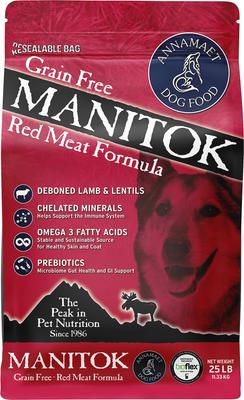
Grain-Free Manitok Red Meat Formula Dry Dog Food, 25-lb bag
Annamaet Grain-Free Manitok Red Meat Formula Dry Dog Food, 25-lb bag earns a Sniff Score of 59/100 (C) with Fair evidence. 1 controversial ingredient flagged. Score capped at 59 due to no AAFCO statement.
Graded by The Sniff System
Reasonable protein quality. lamb delivers solid amino acid coverage.
Quality fat sources: named fat with marine oil (EPA and DHA source).
Named fresh meat paired with same-species meal, a strong extrusion architecture.
No AAFCO statement. Nutritional completeness unverified.
Contains high legume stacking. Multiple pulse-family ingredients in top 15. Mitigated by taurine supplementation or organ meat (natural taurine precursor) in top 10..
Read why each ingredient is good or bad for dogs.
- 1protein animallamb
Real meat. Often used for dogs with chicken or beef sensitivities. Slightly higher fat content than chicken.
- 2protein animallamb meal
Lamb cooked down to a dry concentrate. Per pound, more protein than fresh lamb.
- 3legumelentils
Same concern as peas. Affordable plant protein, but when they pile up in the top 5 ingredients, it's a flag. See why →
- 4legumepeas
Cheap protein bulk. Fine in small amounts, but when peas stack with lentils and chickpeas in the top ingredients, it's the pattern the FDA flagged in its heart-disease investigation. See why →
- 5protein animalherring meal
Concentrated herring with the water removed. Carries protein and omega-3s in one ingredient.
- 6fatcanola oil
Plant oil. Some omega-3 from the parent plant, though dogs absorb it less efficiently than fish-derived omega-3. Fine in moderation.
- 7legumechickpeas
Also called garbanzo beans. Affordable plant protein source, part of the legume stack the FDA examined in its heart-disease investigation. See why →
- 8tapioca
Starch from cassava root. Highly digestible energy source, but pure starch with minimal nutrition beyond that.
- 9pea protein isolate
- 10menhaden oil
- 11dried apples
Real fruit, some fiber and antioxidants. The amount in kibble is too small to matter much.
- 12othernatural flavor
Legal term for animal-derived flavoring, usually hydrolyzed liver or broth. Adds taste, says nothing about quality.
- 13marine microalgae
- 14fiberdried chicory root
Natural prebiotic. Feeds beneficial gut bacteria. The same compound (inulin) used in human gut-health products.
- 15lecithin
Natural emulsifier, usually from soy or sunflower. Helps blend fats and water. Safe at typical inclusion.
- 16dl methionine
- 17fruitblueberries
Antioxidants, real. But the amount in any kibble is too small to do much. Mostly marketing.
- 18fruitcranberries
Often added with a urinary-tract-support marketing angle. Real cranberry compounds help in concentrate form, but kibble doses are small.
- 19supplementl-lysine
Essential amino acid. Plant-protein-heavy formulas sometimes add it to round out the amino acid profile.
- 20supplementtaurine
Amino acid critical for heart health. Especially important in grain-free or pulse-heavy formulas where natural taurine precursors run thin.
- 21monosodium phosphate
Mineral source and preservative. Standard inclusion at small doses.
- 22lactobacillus acidophilus fermentation product dehydrated
- 23mineralsalt
Sodium chloride. Required at small doses for normal physiology. Not a quality concern in standard amounts.
- 24vitaminvitamin e supplement
Required nutrient and a natural antioxidant. Often pulls double duty as a preservative.
- 25l-ascorbyl-2-polyphosphate
A stable form of vitamin C used in pet food. Provides antioxidant support and survives processing better than plain ascorbic acid.
Showing first 25 of 46. Position 1-5 has the largest weight in the recipe.
20 of 25 ingredients have a curated note. Coverage grows over time.